
Ministry of Economy and UN World Food Programme discussed expansion of humanitarian initiatives
March 3, 2026
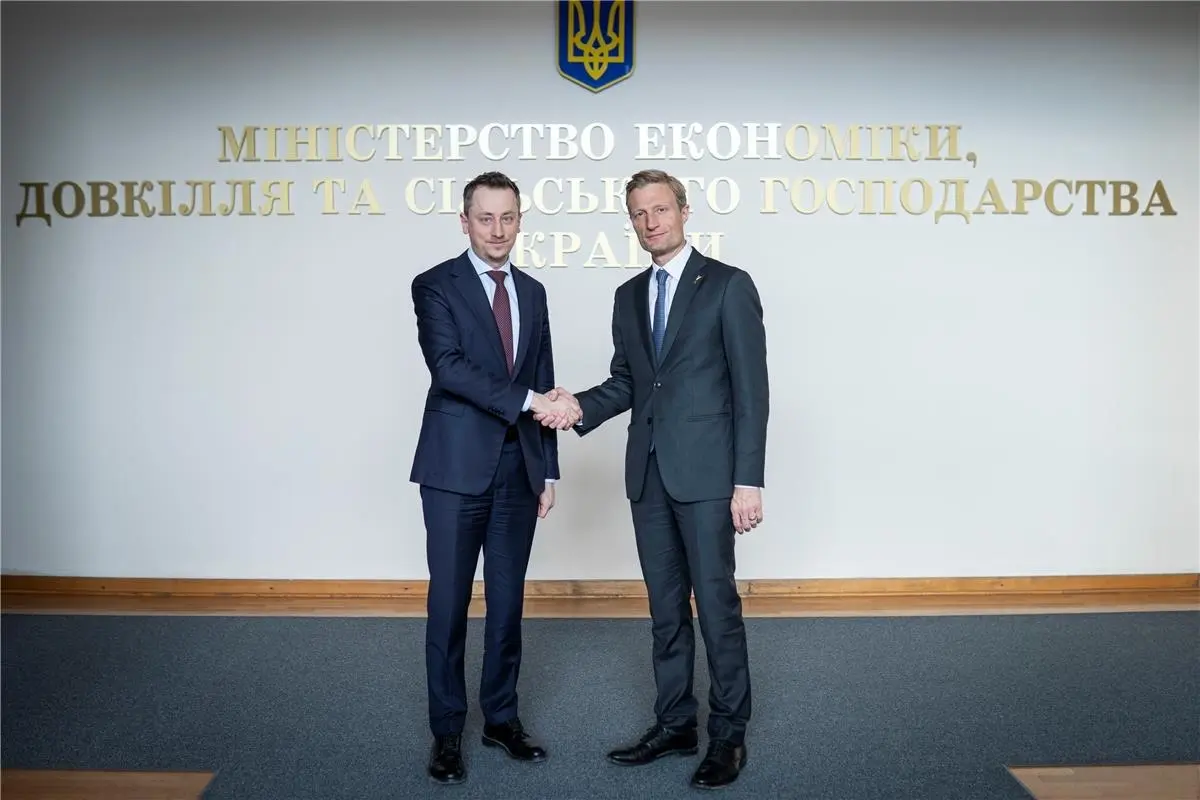
A meeting with the delegation of the UN World Food Programme (WFP) was held at the Ministry of Economy, during which an agreement was reached to deepen strategic cooperation under the humanitarian initiative "Food from Ukraine," develop an international array of agricultural hubs, and scale up programs for humanitarian demining and rural community recovery.
The event was attended by Oleksii Sobolev, Minister of Economy, Environment and Agriculture of Ukraine, Deputy Ministers Denys Bashlyk and Ihor Bezkaravainyi, Deputy Executive Director of the UN World Food Programme (WFP) Carl Skau, WFP Country Director in Ukraine Richard Ragan, and representatives of the organization.
The Ukrainian side thanked WFP for many years of support and sustained partnership. Since the start of the full-scale war, the program has invested nearly $2 billion into the Ukrainian economy, specifically through food procurement for humanitarian needs. Due to collaboration with WFP and other humanitarian organizations, it has been possible to preserve or create about 4,000 jobs for small and medium farming businesses, as well as to support production in frontline areas.
The central topic of the negotiations was the scaling of the "Food from Ukraine" humanitarian initiative as the next stage of the "Grain from Ukraine" program. It involves a gradual transition from raw material exports to establishing a network of international agrifood hubs in African and Middle Eastern countries.
"A promising area of our cooperation is the development of the 'Food from Ukraine' initiative and an array of agricultural hubs in Africa. We have already moved to practical steps for launching the first hub in Ghana and plan to expand this initiative in the Democratic Republic of the Congo and the UAE. Such a model allows us to simultaneously support Ukrainian farmers and assist Global South countries in combating food crises. We count on continued WFP leadership in partnership with Ukraine to scale up Food from Ukraine," noted Oleksii Sobolev.
The first regional agricultural hub is planned to be deployed in Ghana, where the reconstruction of storage and production facilities and local pasta production from Ukrainian flour have already begun. It's anticipated that ready-made food kits will blend Ukrainian and locally produced inventory, functioning as regional logistics centers for rapid response to food crises.
The parties gave special attention to expanding WFP and UN Food and Agriculture Organization (FAO) cooperation in the context of humanitarian demining of farmlands and their rehabilitation.
WFP was among the first international partners to support the Ukrainian demining compensation program for farmers. Presently, the state is scaling the program, fully covering 100% of the agricultural land demining cost, and the Centre for Humanitarian Demining is reinforcing its coordinating role in this process. Two models of future collaboration are being discussed – funding by WFP with bidding through Ukrainian mechanisms or deploying national expertise during procurement subject to WFP procedures.
Both sides confirmed their intent to continue high-level engagement to widen WFP and FAO coordination in demining and land restoration, whilst securing the implementation of WFP's Interim Strategic Plan in Ukraine up to 2027. Ukraine and WFP affirmed a common objective – to fortify national institutions, accelerate the recovery of the agricultural sector, and provide a tangible socioeconomic impact both for Ukrainian communities and countries in need of vital food support.
"Food from Ukraine" represents a new phase of the "Grain from Ukraine" initiative, launched by Ukrainian President Volodymyr Zelenskyy in 2022 to boost Ukraine's role in addressing the global food crisis. Its primary concept lies in delivering value-added products to nations in Asia, Africa, the Middle East, and other starvation-threatened regions, emphasizing steady logistics.
Since 2022, under Ukraine's humanitarian initiatives, over 324 thousand tons of agricultural commodities (wheat and flour, corn, peas, oil) have been dispatched to 19 African and Asian nations under the initiative: Bangladesh, Djibouti, Congo, Yemen, Ethiopia, Zambia, Kenya, Mauritania, Malawi, Mozambique, Nigeria, Pakistan, Palestine, Somalia, Sudan, South Sudan, Syria, Tanzania, Chad, and Pakistan. Over 380 million USD of donor funds were secured overall to carry out the initiatives.